How to Make Your Software Engineering Resume Easier to Read
A clear, scannable software engineering resume beats a flashy one. Here's what recruiters actually look for, and how to surface your strongest signal fast.
Updated
Resume Signal
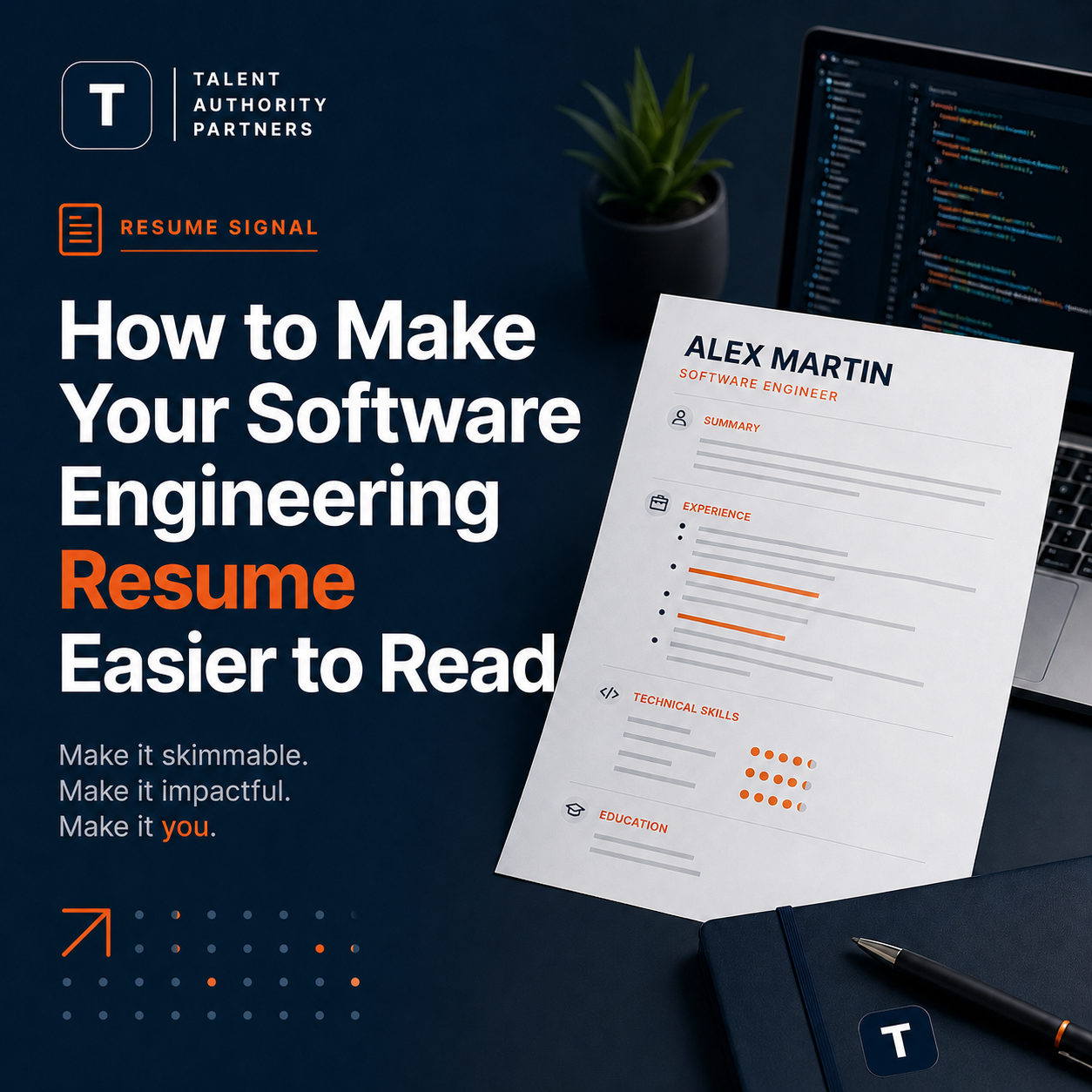
Your software engineering resume does not need to be flashy. It needs to be clear.
A strong engineering resume makes it easy for a recruiter, hiring manager, or technical interviewer to quickly understand what you have built, what technologies you have used, where you are strongest, and whether your background matches the role.
Most resumes do not fail because the candidate is unqualified. They fail because the signal is buried.
If someone has to work too hard to understand your experience, they may move on before they ever realize you are a strong fit.
Key Takeaways
- Your resume should be easy to scan in 30 seconds.
- Lead with your strongest technical signal, not generic summary language.
- Make your frontend, backend, full-stack, AI, cloud, and product experience obvious.
- Separate responsibilities from outcomes.
- Do not make recruiters hunt for your tech stack, work history, or project impact.
- A clean, structured resume usually beats a visually complex one.
Why readability matters so much
Recruiters and hiring teams usually review resumes quickly at first. That first pass is not a deep technical interview. It is a pattern-recognition exercise.
They are asking questions like:
- Does this person match the role?
- Have they built similar products or systems?
- Are they frontend, backend, full-stack, platform, AI, mobile, or something else?
- What technologies have they actually used professionally?
- Are they senior enough?
- Is their recent experience relevant?
- Is there anything that creates uncertainty?
Your resume should answer those questions fast.
If your resume is hard to scan, even strong experience can look weaker than it is.
Start with a simple headline
Your headline should quickly tell the reader what kind of engineer you are.
Weak headline:
Software Engineer
Better headline:
Full-Stack Software Engineer | React, TypeScript, Node.js, AWS
Even better if it reflects your actual lane:
Product-Focused Full-Stack Engineer | React, TypeScript, Node.js, AI Tools
Or:
Backend Engineer | Distributed Systems, Python, Go, AWS, PostgreSQL
This helps recruiters and hiring managers immediately place your background into the right category.
Want this applied to your own search?
Make your technical lane obvious
One of the biggest resume mistakes software engineers make is looking too vague.
If you are full-stack, say whether you lean frontend, backend, or balanced.
Examples:
- Full-Stack Engineer, frontend-leaning
- Full-Stack Engineer, backend-leaning
- Product Engineer, full-stack
- Frontend Engineer with backend exposure
- Backend Engineer with cloud infrastructure experience
- AI-enabled Product Engineer
- Platform Engineer
- Data Engineer
- Machine Learning Engineer
This matters because companies are rarely just hiring a generic "engineer." They are hiring for a specific gap on the team.
A hiring manager may need someone who can own frontend architecture, build APIs, improve backend performance, ship product features, work closely with design, or integrate AI tooling into the product. Your resume should make your fit obvious.
Don't build it from scratch.
Start with the template.
We built the software engineering resume template we wish every candidate would send us: already structured around everything in this article. Clear headline, obvious lane, scannable stack, real outcomes.
Engineered to stand out in four places at once:
- →AI parsers & ATS: clean structure, parseable sections, the right keywords in the right places.
- →Hiring managers: stack, lane, and impact obvious in the first 10 seconds.
- →HR & talent teams: easy to route, easy to shortlist, easy to champion.
- →Recruiters (including us): we instantly see where you fit.
Free. No gimmicks. The template our recruiters wish they saw every day.
Put your strongest signal near the top
The top third of your resume matters most.
That area should usually include:
- Name and contact information
- Location or remote preference
- Target title or headline
- Core technologies
- Brief summary, if useful
- Links to LinkedIn, GitHub, portfolio, or personal site
Avoid long paragraphs at the top. A 5-line summary full of generic language usually does not help.
Weak summary:
Results-driven software engineer with a passion for building scalable applications and collaborating with cross-functional teams.
Better summary:
Full-stack software engineer with 6 years of experience building React, TypeScript, Node.js, and AWS applications. Strongest in product-facing engineering, API development, AI-assisted development workflows, and shipping features in fast-moving startup environments.
The second version gives the reader actual signal.
Your tech stack should be easy to find
Do not hide your technologies inside dense bullet points only.
Add a clean technical skills section that is grouped by category.
Example:
Languages: TypeScript, JavaScript, Python, SQL
Frontend: React, Next.js, Tailwind, HTML, CSS
Backend: Node.js, Express, FastAPI, REST APIs, GraphQL
Databases: PostgreSQL, MongoDB, Redis
Cloud/DevOps: AWS, Docker, GitHub Actions, Vercel
AI Tools: Cursor, Claude Code, GitHub Copilot, OpenAI API
Testing: Jest, Cypress, Playwright
This helps both recruiters and technical reviewers quickly understand your environment.
Do not list every technology you have ever touched
A resume is not a keyword landfill.
If you list every tool you have ever seen, you make it harder to understand where you are actually strong.
There is a big difference between:
- Used professionally for years
- Used in one side project
- Touched once during a tutorial
- Familiar with conceptually
Your resume should emphasize the tools you can confidently discuss in an interview.
If you want to include secondary tools, group them carefully. Do not let them compete with your core stack.
Make every job easy to understand
Each role should quickly answer:
- What company did you work for?
- What was your title?
- When did you work there?
- What kind of product, system, or team did you support?
- What technologies did you use?
- What did you build, improve, own, or ship?
- What changed because of your work?
A strong structure looks like this:
Company Name: Full-Stack Software Engineer
Location or Remote | Month Year to Month Year
Tech: React, TypeScript, Node.js, PostgreSQL, AWS
- Built and maintained customer-facing product features across React, TypeScript, and Node.js.
- Improved application performance by reducing dashboard load times from 4.2 seconds to 1.8 seconds.
- Developed REST APIs supporting account management, billing workflows, and internal admin tools.
- Partnered with product and design to ship features used by 20,000+ monthly active users.
This is much easier to scan than a dense paragraph.
Separate responsibilities from impact
Responsibilities tell people what you were assigned to do.
Impact tells people why it mattered.
Both can be useful, but strong resumes include impact whenever possible.
Responsibility-only bullet:
Worked on backend APIs for customer dashboard.
Better bullet:
Built backend APIs for customer dashboard workflows, reducing manual support requests by 18% and improving account update speed for users.
If you do not have metrics, you can still show impact.
Example:
Rebuilt internal admin workflows that allowed support and operations teams to resolve customer account issues without engineering support.
That still tells the hiring team why the work mattered.
Use numbers, but do not force fake metrics
Metrics are helpful when they are real.
Good metrics include:
- Revenue impact
- User growth
- Performance improvements
- Latency reduction
- Cost savings
- Conversion improvement
- Uptime
- Scale
- Team size
- Codebase size
- Number of services
- Number of users
- Time saved
- Deployment frequency
But do not invent numbers.
If you do not know the exact metric, use grounded context:
- High-volume
- Customer-facing
- Used by the sales team
- Supporting enterprise clients
- Serving thousands of users
- Reduced manual work for internal teams
- Improved reliability of recurring workflows
The goal is not to decorate the resume. The goal is to make the work easier to understand.
Make AI exposure clear if it is relevant
More hiring teams are looking for engineers who understand how AI is changing product development and software delivery.
If you have used AI tools professionally, make that visible.
Examples:
- Used Cursor and Claude Code to accelerate frontend development, refactoring, and test generation.
- Integrated OpenAI API into customer-facing workflow automation features.
- Built prompt evaluation workflows for internal AI support tools.
- Used GitHub Copilot in daily development while maintaining manual code review and testing standards.
- Developed AI-assisted admin tools to summarize customer activity and reduce manual review time.
Do not exaggerate. But if you have meaningful AI exposure, do not bury it.
Keep formatting clean
Your resume should look modern, but it should not be overdesigned.
Avoid:
- Tiny fonts
- Multiple columns that break parsing
- Heavy graphics
- Skill bars
- Icons that replace words
- Dense blocks of text
- Unclear date formatting
- Fancy templates that make content harder to read
A clean one-column or simple two-column format usually works best.
Applicant tracking systems, recruiters, and hiring managers all benefit from clarity.
Make job changes easy to understand
If you have several short stints, contract roles, startup pivots, layoffs, or project-based work, do not make the reader guess.
You can add light context directly into the resume.
Examples:
- Contract role
- Company acquired
- Startup downsized
- Project-based engagement
- Role eliminated after funding change
- Short-term consulting engagement
You do not need to over-explain. Just remove unnecessary uncertainty.
Include links that actually help
For software engineers, links can matter.
Useful links include:
- GitHub
- Portfolio
- Personal website
- Deployed project
- Technical blog
- Open-source contributions
Make sure the links work. Make sure the content supports your candidacy.
A GitHub with old school projects is not automatically helpful. A portfolio with clear project explanations, technical decisions, and product context can be much more valuable.
Keep it focused on the role you want
Your resume should not try to win every possible job.
If you want frontend roles, make frontend strength obvious.
If you want backend roles, lead with backend systems, APIs, architecture, scale, and reliability.
If you want product engineering roles, emphasize user-facing features, product collaboration, shipping speed, design partnership, and business impact.
If you want AI product engineering roles, show where you have used AI tools, APIs, prompt workflows, model integrations, or AI-assisted development in real work.
The more focused your resume is, the easier it is for the right hiring team to say yes.
Final Thought
A strong software engineering resume is not about sounding impressive. It is about being understood quickly.
Recruiters and hiring teams are not looking for mystery. They are looking for signal.
Make your technical lane clear. Make your impact easy to see. Make your tools easy to find. Make your strongest experience impossible to miss.
That is what gives your resume a better chance of turning into an interview.
Next Step
Ready for your next role? Join the Talent Authority Partners Talent Network, or keep reading the Knowledge Center for practical recruiter-backed advice.

Jonathan Tureau
Founder & Principal Recruiter, Talent Authority Partners
Founder-led, on every search. 17 years in recruiting, and a third-generation recruiter.
About JonathanWant this applied to your own search?
Related reading
How AI Tools Are Changing Software Engineering Hiring
AI exposure is becoming a real hiring signal, but only when it's specific. Here's what hiring teams actually want to hear about your AI workflow.
Jonathan Tureau · Jun 3, 2026 · 6 min read
What Recruiters Look For in Strong Software Engineering Candidates
Strong engineering candidates aren't always the ones with the longest resumes. They're the ones who make their fit easy to understand.
Jonathan Tureau · Jun 3, 2026 · 6 min read
The Golden Question: The #1 Interview Question to Maximize Your Chances of Getting the Job
One question, asked early in every interview, that tells you exactly where you stand and gives you a chance to close the gap.
Jonathan Tureau · Jun 2, 2026 · 11 min read