The Golden Question: The #1 Interview Question to Maximize Your Chances of Getting the Job
One question, asked early in every interview, that tells you exactly where you stand and gives you a chance to close the gap.
Updated
Most candidates walk into interviews trying to impress.
The strongest candidates walk in trying to understand.
That difference matters.
Because an interview is not just about proving that you are qualified. It is about proving that you are qualified for what this specific interviewer cares about most.
That is where most candidates get it wrong.
They read the job description. They prepare answers. They rehearse their background. They think through their strengths. Then they walk into the interview and start selling themselves before they fully understand what the interviewer actually wants to buy.
That is backwards.
The best thing you can do early in an interview is uncover the interviewer’s real scorecard.
And the best way to do that is by asking what I call The Golden Question.
The Golden Question
Early in the interview, say this:
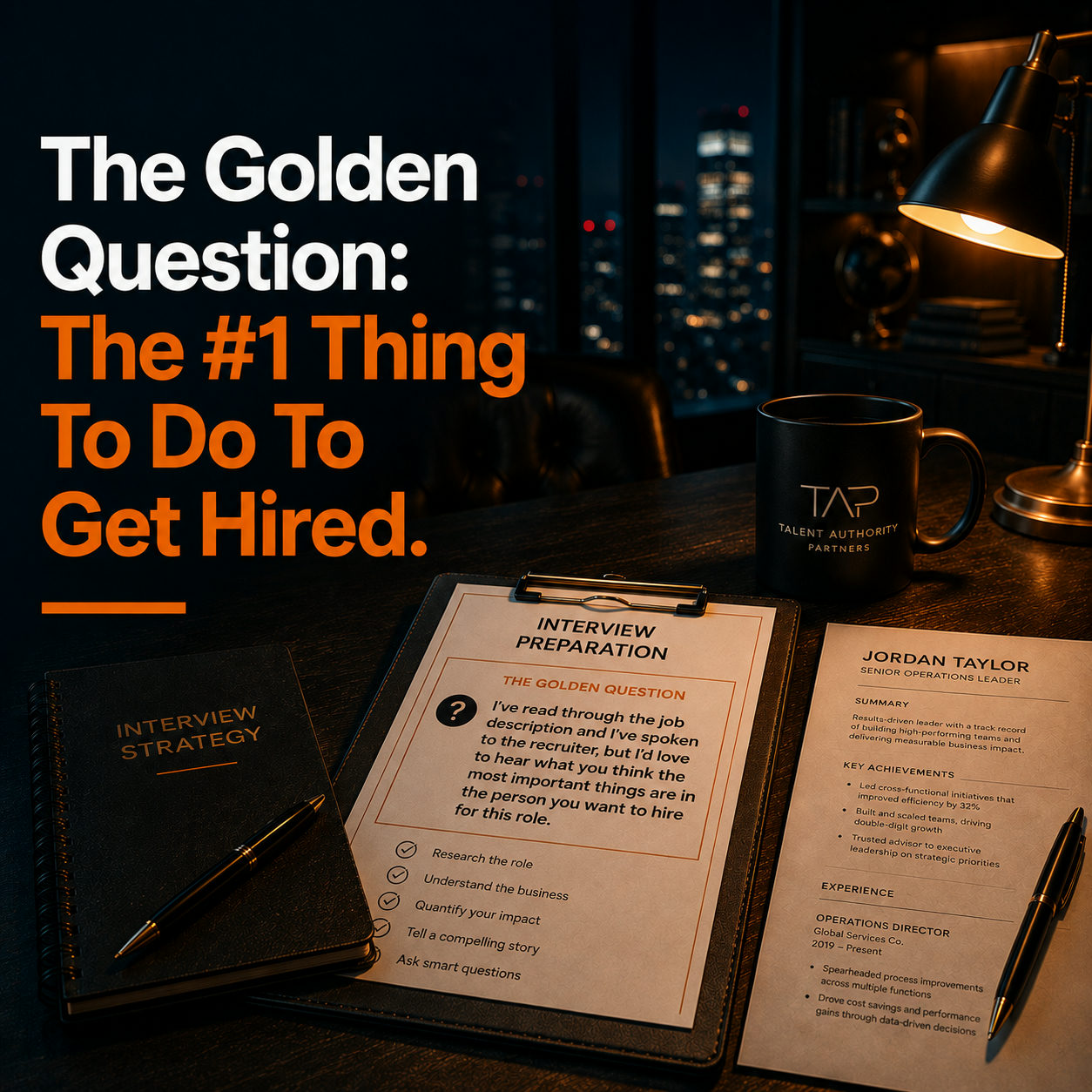
“I’ve read through the job description and I’ve spoken to the recruiter, but I’d love to hear what you think the most important things are in the person you want to hire for this role.”
That is the question.
It is simple, but it is incredibly powerful.
You are not asking, “Can you tell me about the role?”
You are not asking, “What are you looking for?”
You are not asking something generic that makes it sound like you did not prepare.
You are making it clear that you have done your homework. You read the job description. You already spoke with the recruiter. But now you want to hear directly from the person interviewing you.
That matters because every interviewer has their own perspective.
The recruiter may care about the official requirements.
The hiring manager may care about team gaps.
A peer interviewer may care about collaboration.
An executive may care about business impact.
A technical interviewer may care about depth, problem-solving, architecture, or speed.
The same role can look different depending on who is evaluating you.
That is exactly why the wording matters.
You are asking what they think the most important things are.
Not skills.
Not qualifications.
Not requirements.
Things.
That word is important because it leaves room for the interviewer to define what matters in their own way.
They may talk about technical ability. They may talk about ownership. They may talk about communication. They may talk about urgency, accuracy, leadership, coachability, judgment, stability, product thinking, customer empathy, or the ability to work without hand-holding.
You do not know until you ask.
And once they answer, you have your roadmap.
Why This Question Works
The Golden Question works because it gives you insight into the interviewer’s internal scorecard.
Every hiring decision has a scorecard, whether it is written down or not.
Sometimes that scorecard is formal. Sometimes it is informal. Sometimes it only exists in the hiring manager’s head.
But it is always there.
They are asking themselves:
Can this person do the work?
Will this person make my life easier?
Will this person solve the problem we need solved?
Will this person fit the team?
Can I trust this person?
Are they better than the other people I am interviewing?
The job description may list 15 responsibilities and 12 qualifications, but the interviewer may only truly care about three things.
The Golden Question helps you find out what those three things are.
Once you know that, you can stop guessing.
You can stop giving generic answers.
You can stop hoping that something in your background lands.
Instead, you can highlight the parts of your experience that directly connect to what they just told you matters most.
That is the entire point.
This Is the Same Strategy Great Salespeople Use
The Golden Question works for the same reason great sales conversations work.
Strong salespeople do not start by pitching every feature of their product.
They first figure out what the customer cares about.
They ask questions.
They uncover pain points.
They learn what matters.
They identify what problem the customer is trying to solve.
Then they sell based on that information.
Interviewing works the same way.
You are not manipulating anyone. You are not playing a game. You are simply making sure you understand what matters before you start positioning yourself.
A weak candidate gives the same answer to every interviewer.
A strong candidate listens, adjusts, and connects their background to the specific needs of the person in front of them.
That is what the Golden Question allows you to do.
It turns the interview from a generic performance into a focused business conversation.
Want this applied to your own search?
Most Candidates Interview Blind
Most candidates answer questions before they understand the target.
They hear, “Tell me about yourself,” and immediately launch into a long overview of their background.
They talk about their career path, their experience, their tools, their projects, and their interests.
Some of that may be relevant.
Some of it may not be.
The problem is that they do not yet know what the interviewer is listening for.
That is a massive disadvantage.
Because if you spend the first 10 minutes talking about things the interviewer does not care about, you may already be losing the interview.
The Golden Question prevents that.
It gives you the target before you start shooting.
How to Use the Answer
Asking the question is only step one.
The real value comes from what you do after they answer.
Use this simple framework:
Ask. Listen. Confirm. Bridge.
First, ask the Golden Question:
“I’ve read through the job description and I’ve spoken to the recruiter, but I’d love to hear what you think the most important things are in the person you want to hire for this role.”
Then listen carefully.
Do not interrupt.
Do not immediately jump in and start selling.
Pay attention to the exact words they use.
If they say they need someone who can “own things,” that tells you something.
If they say they need someone who can “move fast,” that tells you something.
If they say they need someone who can “work across teams,” that tells you something.
If they say they need someone who can “bring structure,” “handle ambiguity,” “go deep technically,” “communicate with customers,” or “operate independently,” that is your roadmap.
Then confirm what you heard.
For example:
“That makes sense. So it sounds like the biggest things you’re looking for are ownership, speed, and someone who can work well in ambiguity.”
Now bridge your background directly to those priorities:
“That lines up closely with the work I’ve been doing. In my current role, I’ve had to own projects end-to-end with limited structure, move quickly, and make decisions without waiting for perfect information. A good example would be…”
That is how you turn a normal answer into a targeted answer.
You are no longer just talking about yourself.
You are showing them why your background matches what they just told you they need.
Example: The Average Candidate vs. The Strategic Candidate
Here is how most candidates answer “Tell me about yourself.”
“Sure. I have about six years of experience in software engineering. I’ve worked with React, TypeScript, Node, and AWS. In my current role, I build frontend and backend features, collaborate with product, and help improve our internal systems. I’m looking for a role where I can keep growing and work on meaningful products.”
That answer is not terrible.
But it is generic.
Now compare that to a candidate who asks the Golden Question first.
Candidate:
“Absolutely. I’m happy to walk you through my background. Before I do, I’ve read through the job description and I’ve spoken to the recruiter, but I’d love to hear what you think the most important things are in the person you want to hire for this role.”
Interviewer:
“The biggest things are ownership, product judgment, and speed. We are a small team, so we need someone who can take a feature, understand the user problem, work with product and design, and ship without needing constant direction.”
Candidate:
“That makes sense. So ownership, product judgment, and speed are the big things. That actually lines up very closely with my current role. I’ve been working in a lean product engineering environment where I own features from early requirements through launch. I work directly with product and design, make technical tradeoffs, and ship quickly without a lot of hand-holding. One example that’s especially relevant is…”
That answer is far stronger.
Not because the candidate suddenly became more qualified.
Because the candidate is now answering against the interviewer’s actual priorities.
That is the power of the Golden Question.
Why “Things” Is the Right Word
The word things may seem simple, but it is one of the most important parts of the question.
If you ask, “What skills are most important?” the interviewer may only talk about hard skills.
If you ask, “What qualifications are most important?” they may repeat the job description.
If you ask, “What requirements are most important?” they may stay surface-level.
But when you ask what the most important things are, you give them room to answer honestly.
They may say:
“Honestly, we need someone who can just figure things out.”
That tells you they care about resourcefulness.
They may say:
“We need someone who can communicate clearly with non-technical stakeholders.”
That tells you communication may matter as much as technical skill.
They may say:
“We need someone who can bring structure to a messy environment.”
That tells you they are dealing with chaos, process gaps, or lack of accountability.
They may say:
“We need someone who is low ego and collaborative.”
That tells you there may be team dynamics they are trying to protect or improve.
These are the things that often do not show up clearly in a job description.
But they absolutely influence who gets hired.
When to Ask the Golden Question
The best time to ask is early in the interview.
Ideally, ask it before you give your full background overview.
A natural setup is:
“Absolutely, I’m happy to walk you through my background. Before I do, I’ve read through the job description and I’ve spoken to the recruiter, but I’d love to hear what you think the most important things are in the person you want to hire for this role.”
This works because it does not interrupt the flow of the conversation.
It also makes you sound prepared, thoughtful, and focused.
You are saying:
I know the basics.
I did the work.
Now I want to understand what matters most from your perspective.
That is a strong way to start.
How This Helps You Throughout the Rest of the Interview
The Golden Question does not just help with your first answer.
It helps with the entire conversation.
Once the interviewer tells you what matters, you can use those insights throughout the rest of the interview.
When they ask about your experience, you can choose the examples that connect to their priorities.
When they ask about challenges, you can frame your answer around the traits they care about.
When they ask why you are interested in the role, you can connect your motivation to the problems they need solved.
When they ask if you have questions, you can ask deeper follow-ups around the things they said were important.
When you close the interview, you can reinforce the match.
For example:
“Based on what you shared earlier, it sounds like ownership, speed, and product judgment are the biggest priorities. Those are exactly the areas where I think my background lines up well, especially given the work I’ve done owning full-stack product features in fast-moving environments.”
That is a much stronger close than:
“Thanks for your time. I’m really interested in the role.”
It shows you listened.
It shows you understood the scorecard.
It shows you can connect your experience to their needs.
Versions of the Golden Question
The core question should stay the same, but you can adjust it slightly depending on who you are speaking with.
For a hiring manager:
“I’ve read through the job description and I’ve spoken to the recruiter, but I’d love to hear what you think the most important things are in the person you want to hire for this role.”
For a recruiter:
“I’ve read through the job description, but based on your conversations with the hiring team, what do they seem to care about most in the person they hire for this role?”
For a technical interviewer:
“I’ve read through the role, but from your perspective, what are the most important things you’re evaluating for in this conversation?”
For a final interview:
“At this stage, what are the most important things you would need to feel confident that someone is the right hire for this role?”
The point is the same every time.
You are trying to understand the scorecard before you sell yourself against it.
What Not to Do
The Golden Question is powerful, but only if you use it correctly.
Do not ask it and then ignore the answer.
If they tell you they care about ownership, show ownership.
If they tell you they care about communication, show communication.
If they tell you they care about technical depth, give them depth.
If they tell you they need someone who can operate in ambiguity, do not position yourself as someone who needs perfect structure.
The answer they give you is not small talk.
It is the map.
Use it.
Also, do not ask the question in a way that sounds like you skipped preparation.
Weak version:
“So, what are you looking for?”
That sounds lazy.
Strong version:
“I’ve read through the job description and I’ve spoken to the recruiter, but I’d love to hear what you think the most important things are in the person you want to hire for this role.”
That sounds prepared.
That sounds strategic.
That sounds like someone who wants to make the conversation valuable.
Why This Is the #1 Thing You Can Do to Improve Your Interview Performance
There are many things that help in an interview.
You should research the company.
You should understand the role.
You should know your resume.
You should prepare examples.
You should practice explaining your impact clearly.
All of that matters.
But the Golden Question is different because it improves everything that happens after it.
It improves your introduction.
It improves your examples.
It improves your answers.
It improves your follow-up questions.
It improves your close.
It helps you avoid wasting time on the wrong points.
Most importantly, it helps you understand what this specific interviewer wants to hear from you.
That is why this question is so powerful.
It gives you the roadmap.
It gives you the scorecard.
It gives you the pain points.
And once you know those things, you can position your background much more effectively.
A note on using this well: the goal is to understand the interviewer's priorities honestly, not to manipulate the conversation. Ask early, listen carefully, and let the answer guide how you present your real experience.
Final Thought
Most candidates try to sell themselves too early.
The best candidates first understand what matters.
Then they sell.
That is the strategy behind the Golden Question.
“I’ve read through the job description and I’ve spoken to the recruiter, but I’d love to hear what you think the most important things are in the person you want to hire for this role.”
Ask it early.
Listen carefully.
Use the answer as your roadmap.
Then spend the rest of the interview showing them exactly why your background matches what they care about most.
That one question can change the entire interview.

Jonathan Tureau
Founder & Principal Recruiter, Talent Authority Partners
Founder-led, on every search. 17 years in recruiting, and a third-generation recruiter.
About JonathanWant this applied to your own search?
Related reading
How AI Tools Are Changing Software Engineering Hiring
AI exposure is becoming a real hiring signal, but only when it's specific. Here's what hiring teams actually want to hear about your AI workflow.
Jonathan Tureau · Jun 3, 2026 · 6 min read
What Recruiters Look For in Strong Software Engineering Candidates
Strong engineering candidates aren't always the ones with the longest resumes. They're the ones who make their fit easy to understand.
Jonathan Tureau · Jun 3, 2026 · 6 min read
How to Make Your Software Engineering Resume Easier to Read
A clear, scannable software engineering resume beats a flashy one. Here's what recruiters actually look for, and how to surface your strongest signal fast.
Jonathan Tureau · Jun 3, 2026 · 8 min read