The 90-Day Executive Onboarding Plan That Reduces Early Turnover Risk
Executive turnover is often blamed on the hire, but onboarding plays a real role too. Here's the 90-day plan that reduces early turnover risk and closes the gap between a great hire and a great fit.
Updated
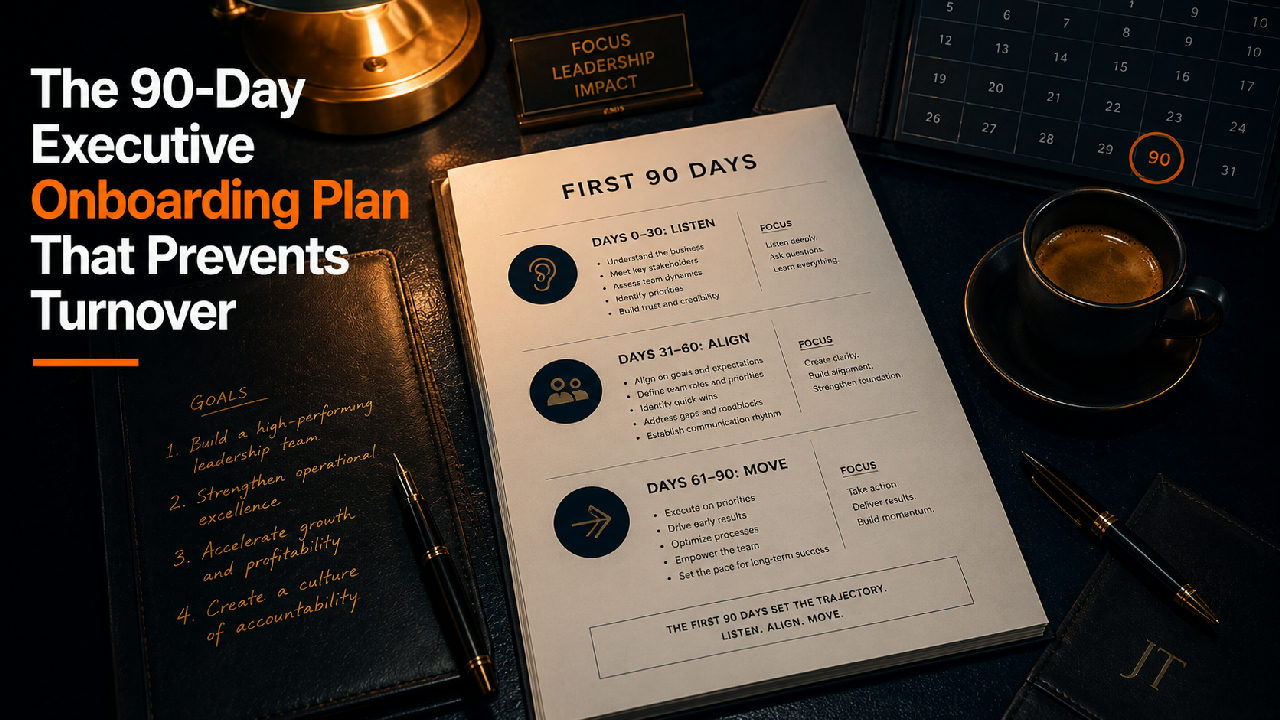
The first ninety days of an executive's tenure are the period that decides whether the hire works. Not the interview. Not the offer. The ramp.
Companies invest enormous time and money into finding the right leader and then turn the onboarding over to a generic "first week" deck, a flurry of introductions, and the assumption that a senior person will figure the rest out. Sometimes that works. When it doesn't, the departure often gets blamed on the candidate rather than the onboarding process itself.
Executive onboarding is not orientation. It's a structured 90-day plan that the hiring manager, the new executive, and the team co-own. When it's run well, the executive lands. When it's not, the executive drifts, and the drift compounds.
Why Most Executive Onboarding Fails
A few patterns explain the bulk of failed executive ramps.
No defined success criteria. The new executive doesn't know what counts as winning in the first ninety days. Neither does the hiring manager. So there's no shared scorecard, no honest checkpoint, and no early signal when something is drifting.
Drinking from a firehose without a map. Calendars get jammed with meet-and-greets. The executive emerges from week three exhausted, having met fifty people, with no clear picture of what's actually broken, where the leverage is, or what to do first.
Premature decisions. The pressure to "show impact" leads new executives to make big calls in their first 30-60 days (reorgs, strategy pivots, key terminations) before they have the context to make those calls well. Half of those decisions get unwound. The team loses confidence.
Late or absent honest conversation. The hiring manager checks in vaguely ("how's it going?"), gets vague answers ("good, lots to learn"), and misses the early signals that the fit is off. By the time the conversation gets real, the executive has already started checking out.
The Three-Phase Structure
A high-functioning executive onboarding plan breaks the first 90 days into three phases with distinct objectives.
Days 0-30: Listen, Learn, Map
The first month is for understanding, not action. The executive's job is to build a private map of the company (the people, the systems, the customers, the dynamics, the obstacles, the political topography) that everyone else takes for granted.
What this looks like in practice:
1:1s with every direct report, every peer, key cross-functional partners, key customers, and the board if relevant
Listening sessions with the team: what's working, what isn't, what's been tried, what got dropped
Quiet observation of operating rhythms: how meetings run, who actually decides, where conflict happens
A read of the data: pipeline, P&L, retention, customer churn, whatever's relevant to the role
A weekly written reflection to the hiring manager (private, candid) about what the executive is learning
What should not happen in this phase: major decisions, reorgs, public strategy declarations, or firings. The executive should be famous for asking questions, not for making changes.
Days 31-60: Hypothesis and Alignment
The second month is for translating learning into hypothesis. The executive starts forming a point of view on:
What's working and worth doubling down on
What's broken and worth fixing
What's broken but not worth fixing right now
What's not broken but is misaligned with where the company is going
The 2-3 things this executive uniquely needs to be focused on
That point of view is shared first with the hiring manager, then refined, then shared with the team. The pattern is hypothesis → conversation → revised hypothesis. Not pronouncement.
By the end of day 60, the executive should have a clear, written plan for the next six to twelve months: agreed with the hiring manager, communicated to the team, and resourced appropriately.
Days 61-90: First Visible Moves
The third month is when the executive starts shipping. Not blockbuster changes, but real, visible moves that signal the direction without disrupting the system.
Examples of what "first visible moves" look like in this phase:
For a VP of Sales: a refined pipeline review cadence, a sharpened ICP, two specific deals personally moved forward, one rep development plan put in writing
For a CTO: a documented architectural principle, one prioritization decision that simplifies the roadmap, a hiring plan for the next six months
For a CFO: a tightened forecast process, two operational reports cleaned up, an honest read on cash runway delivered to the board
The goal is for the executive to end day 90 with three things: clear ownership of the seat, demonstrated decision-making, and the trust of the team. Bigger moves come in months 4-9.
What the Hiring Manager Owes the Executive
Onboarding is not a self-serve experience. The hiring manager has real obligations.
Weekly 1:1s, on the calendar, treated as sacred. The first 90 days is the worst possible time to skip or shrink these conversations. The signals are subtle and time-sensitive.
Explicit success criteria in writing. "Here's what we're going to call winning at day 30, day 60, day 90." The act of writing it down forces the hiring manager to actually know.
Air cover for hard early conversations. The executive will surface things that surprise the hiring manager: maybe an under-performing team member they inherited, a process that doesn't work, a customer relationship that's worse than advertised. The hiring manager has to be willing to back the executive's read, not defend the status quo.
Permission to not be perfect. New executives need space to ask questions that might look obvious in retrospect. The hiring manager who reacts with "you should already know that" trains the executive into silence, which is the worst possible posture in the first 90 days.
Hiring for a leadership role? A 20-minute conversation will pressure-test the role before you post it.
What the Executive Owes the Team
In return, the executive has obligations to the people they're leading.
Visibility without overload. Be present, but don't be performative. Don't dominate every meeting in the first 30 days trying to demonstrate value.
Public learning. Acknowledge what you're learning. Quote the team back to itself. "Three of you have told me the same thing about X: I'm taking that seriously." This builds trust faster than any strategy declaration.
Protection of the team during the transition. New executives sometimes throw their team under the bus to look fresh ("here's what was broken when I got here"). That kills credibility. Defend the team in public; address problems in private.
Real, regular communication. A weekly written update to direct reports, even when there's not much to say, signals respect for their need to know what's happening.
The 90-Day Checkpoint
At day 90, the hiring manager and the new executive should have an explicit, scheduled, honest conversation. Not a status update. A real checkpoint.
The conversation covers:
Against the success criteria we wrote down on day one, where did this go well? Where did it not?
What surprised you about the role?
What's harder than you expected?
What's easier?
What do you need from me in the next 90 days?
Is there anything you're hesitant to tell me? (Then make it safe to answer that one honestly.)
This conversation is the difference between an executive ramp that succeeds and one that drifts into a quiet failure. Treat the 90-day plan as adaptable: the specific milestones will vary by role and company, but the discipline of checking in against written expectations is what tends to catch problems early.
If you're hiring an executive and want a partner who thinks about the first 90 days as part of the search, not someone else's problem, talk with Talent Authority Partners. The specific follow-up we provide is outlined in your search agreement.

Jonathan Tureau
Founder & Principal Recruiter, Talent Authority Partners
Founder-led, on every search. 17 years in recruiting, and a third-generation recruiter.
About JonathanHiring for a leadership role? A 20-minute conversation will pressure-test the role before you post it.
Related reading
How to Write an Executive Offer Letter That Gets Signed
An executive offer letter should be written for clarity and candidate experience, not just legal precision. The companies that consistently close finalists understand that, and write the letter that way.
Jonathan Tureau · May 14, 2026 · 6 min read
How to Beat the Counter-Offer: A Hiring Manager's Closing Playbook
A counter-offer at the end of a long search is the moment most hiring managers either close or lose. The ones who close don't do it by paying more. They do it by running a different process from week one.
Jonathan Tureau · May 14, 2026 · 5 min read
Boutique vs. Big Recruiting Firms: When Each One Wins
Big firms and boutique firms aren't competing on the same terms. They're built for different jobs. Here's an honest look at when each one is the right call, and when each one quietly costs you the search.
Jonathan Tureau · May 14, 2026 · 5 min read