How to Beat the Counter-Offer: A Hiring Manager's Closing Playbook
A counter-offer at the end of a long search is the moment most hiring managers either close or lose. The ones who close don't do it by paying more. They do it by running a different process from week one.
Updated
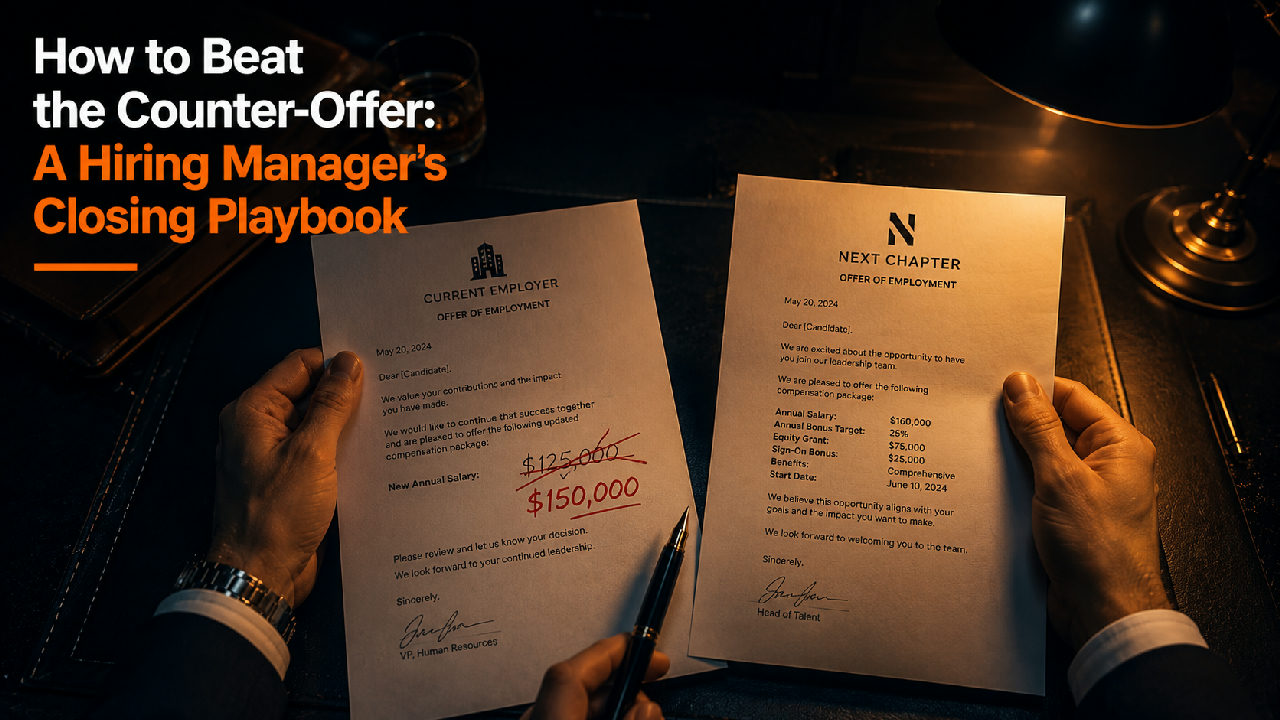
The counter-offer is the predictable plot twist of executive hiring. You ran a great process, identified a strong candidate, made a clean offer, and they came back two days later with "my current company wants to keep me." Now you're competing, and competing reactively, late, with the worst possible leverage.
The mistake is thinking the counter-offer is a problem you solve at the end. By the time the counter lands, most of the outcome is already decided. The hiring managers who consistently close candidates against counter-offers do specific things from week one of the search.
What a Counter-Offer Actually Means
Before the tactics, get the diagnosis right. A counter-offer means one of three things, and the right response depends on which.
The financial counter. The current employer is offering more money to retain the employee. This is the simplest counter and the easiest to predict. The current company didn't want to lose the person, did the math on replacement cost, and decided to pay.
The narrative counter. The current employer is selling a new story: a promotion, a new project, a "we were going to talk to you about this next quarter anyway." This is more dangerous because it's harder to debunk in the moment.
The relationship counter. The current employer pulls on personal loyalty: the candidate is reminded of how much the team needs them, how much the company has invested in them, how they'd be letting people down. This is the most emotionally loaded counter and often the most effective.
Most counters are a mix of all three. Knowing which one is doing the heavy lifting helps you respond.
The Counter-Offer Almost Always Loses Long-Term
Anecdotally, many candidates who accept a counter-offer end up leaving within the following year anyway, because the reasons they wanted to leave in the first place, career stagnation, leadership concerns, a growth ceiling, compensation imbalance, don't get fixed by a raise. They get postponed.
It's worth having this conversation with candidates honestly, not as a scare tactic, but as a real pattern worth weighing.
The Closing Process Starts at Week One
The hiring managers who lose finalists to counter-offers usually run a process that's optimized for speed and selling, not for honest evaluation of motivation. The hiring managers who win do something different from the first conversation: they invest in understanding the candidate's actual decision criteria.
That means asking, every conversation:
What's the real reason you're open to leaving your current role?
What would have to be true for you to say yes to this opportunity?
What would have to happen at your current company for you to stay?
Who else is involved in your decision: spouse, mentor, anyone you'd consult?
What's the worst case scenario you're worried about in this move?
Candidates who feel truly understood by a hiring manager, not pitched to, develop a real relationship with the new opportunity. That relationship is what survives a counter-offer.
Hiring for a leadership role? A 20-minute conversation will pressure-test the role before you post it.
The "Why You're Leaving" Conversation
The most important conversation in the entire hiring process is the one where you understand, in real specifics, why the candidate is open to moving. This isn't a one-time question. It's a thread you pull on through the entire process.
Strong hiring managers will revisit the "why" repeatedly:
In the first conversation: surface-level answer
After the first round: deeper read
In the working session: testing whether the candidate's "why" is consistent under harder questions
Before the offer: reconfirming the "why" is still real
By the time the offer is on the table, both sides should be aligned on what's pulling the candidate toward the new role and what's pushing them away from the current one. When the counter comes, the candidate has already articulated to themselves multiple times why none of it changes the calculus.
The Pre-Counter Conversation
Before you extend the offer, not after, have an explicit conversation about the counter-offer. Something like:
"Before we make this official, I want to acknowledge something. Companies don't lose strong people lightly. There's a real chance your current employer makes a counter-offer when you resign. I want to make sure we're aligned now, not in the moment, about what you'd do. Have you thought through how you'd respond?"
This conversation does several things at once. It normalizes the counter so it's not surprising. It surfaces the candidate's own thinking before they're under emotional pressure. It signals that you respect their process. And it makes any future counter feel pre-handled rather than novel.
A candidate who's done this conversation with you is dramatically less likely to be swayed in the moment.
When the Counter Actually Lands
Despite all the upstream work, sometimes the counter lands. When it does, three things matter.
Speed of response. Don't disappear and let the counter-offer marinate. Get on a call within hours. The longer the candidate sits with the counter alone, the more its narrative wins.
Honest acknowledgement. Don't dismiss the counter or panic. "I expected this to happen, and I want to talk through it honestly with you." The candidate is in a hard spot. Treating them like an adult navigating a real decision earns trust at the moment it matters most.
Reanchor to the original "why." "The reasons you started this process haven't changed. Your current company didn't suddenly become the right place for you: it became a place that was willing to pay more to keep you. That's a meaningful distinction. What changes?"
Then listen. Sometimes the answer surfaces something legitimate: a real opportunity at the current company that wasn't on the table before. Sometimes the answer is "honestly, nothing's changed, I just feel guilty." Either way, naming what you're actually hearing helps.
The Compensation Reality
Sometimes the candidate has a financial reason that's real. Cost of living, family obligation, equity vesting that matters. In those cases, the right move is sometimes to revisit the offer once, cleanly.
But not as a bidding war. The framework: "Here's what we can do, here's why this is what we believe the right offer looks like, here's the timeline we need an answer in." Stretching the offer over and over signals desperation and erodes the candidate's confidence in the company.
If you can't match the counter and the gap is real, sometimes you lose the candidate. That's okay. The price of winning every counter-offer is overpaying on every offer, which has its own downstream cost.
What Search Partners Do Differently
A strong search partner runs the counter-offer conversation upstream as part of the search process, not as a fire drill at the end. They've had the "why you're leaving" conversation, the "what would the current employer say" conversation, and the pre-counter conversation before the offer goes out. By the time a counter lands, both sides know exactly what they're going to do.
That's where the value of having a search partner who actually represents the candidate, not just sourced them, shows up. The candidate trusts the partner enough to be honest about their hesitation, and the partner has the trust to push back when the counter is a bluff.
If you're hiring leadership and want a search partner who builds the counter-offer conversation into the process from week one, Talent Authority Partners can help. We won't help you out-bid the current employer. We'll help you out-think them.

Jonathan Tureau
Founder & Principal Recruiter, Talent Authority Partners
Founder-led, on every search. 17 years in recruiting, and a third-generation recruiter.
About JonathanHiring for a leadership role? A 20-minute conversation will pressure-test the role before you post it.
Related reading
The 90-Day Executive Onboarding Plan That Reduces Early Turnover Risk
Executive turnover is often blamed on the hire, but onboarding plays a real role too. Here's the 90-day plan that reduces early turnover risk and closes the gap between a great hire and a great fit.
Jonathan Tureau · May 14, 2026 · 5 min read
How to Write an Executive Offer Letter That Gets Signed
An executive offer letter should be written for clarity and candidate experience, not just legal precision. The companies that consistently close finalists understand that, and write the letter that way.
Jonathan Tureau · May 14, 2026 · 6 min read
Boutique vs. Big Recruiting Firms: When Each One Wins
Big firms and boutique firms aren't competing on the same terms. They're built for different jobs. Here's an honest look at when each one is the right call, and when each one quietly costs you the search.
Jonathan Tureau · May 14, 2026 · 5 min read