How to Write an Executive Offer Letter That Gets Signed
An executive offer letter should be written for clarity and candidate experience, not just legal precision. The companies that consistently close finalists understand that, and write the letter that way.
Updated
This article offers general, practical guidance on structuring an offer letter for clarity and candidate experience. It is not legal advice. Offer letter language, especially around compensation, equity, non-competes, and termination terms, should be reviewed by qualified employment counsel in your jurisdiction before use.
Most executive offer letters are written by lawyers and HR, optimized for legal precision and policy compliance. They're accurate. They're protective. They're also, almost without exception, the worst possible document to actually close a candidate with.
A great executive offer letter does two jobs at once. It states the legal terms with clarity. And it functions as a closing document: one that reinforces the candidate's belief that this is the right move, on the day they have to make the hardest decision of their year.
When the offer letter does only the first job, the candidate signs it reluctantly or doesn't sign it at all. When it does both, the candidate signs with conviction.
The Mindset Shift
Before any structural advice, the mindset shift: the offer letter is the last document the candidate reads before they tell their current employer they're leaving. It will be read multiple times. It will be shared with a spouse, a mentor, a financial advisor. It will sit on a desk for days.
What it says, and how it says it, matters more than most companies realize.
A purely legalistic offer letter signals coldness, transactionality, and bureaucracy. A warm, clear, well-structured offer letter signals confidence, intentionality, and respect. The candidate is reading both the terms and the tone.
The Structure That Closes
A great executive offer letter has six sections, in this order.
1. Personal opening. Two or three sentences from the hiring manager or CEO, by name. Not "Dear Candidate." Not boilerplate. A real acknowledgement that this is a significant decision and that the team is genuinely excited.
2. The role. Title, reporting structure, direct reports, scope. This is one of the most-read sections. Be specific about who the person reports to (by name and title), who reports to them, and what they own. Ambiguity here creates downstream conflict.
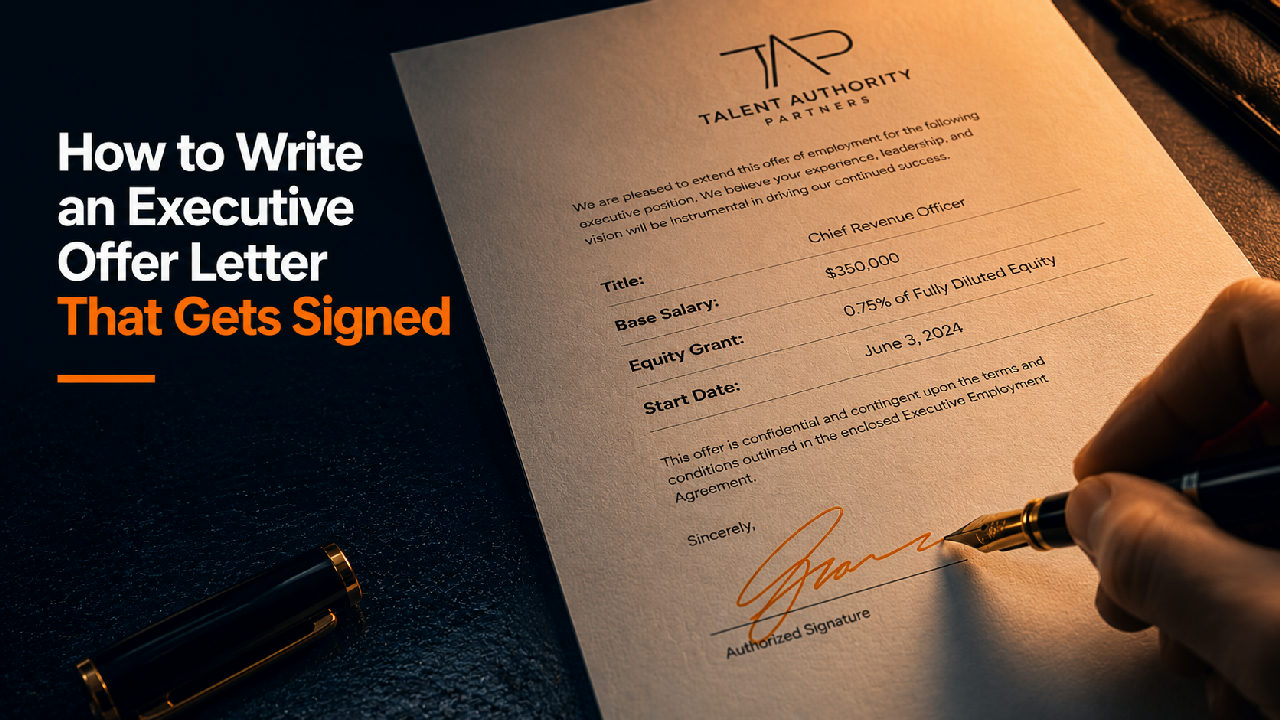
3. Compensation. Base, variable, equity, sign-on, benefits: all on a single page in a clear table or list. Show the math on equity (number of shares, current 409A or strike, vesting schedule). Don't bury the variable structure in a footnote. Don't make the candidate ask for clarification.
4. Start date and onboarding. A specific start date, the onboarding plan, who they'll meet in the first week, and any logistical notes (relocation, IT setup, etc.). This section signals operational competence.
5. Standard terms. Confidentiality, IP assignment, dispute resolution: the legal scaffolding. This belongs in the letter, but it belongs in the back, not the front.
6. A real closing. Another two or three sentences from the hiring manager. Not "we look forward to your response." Something specific about what excites the team about this hire and why they're confident it's the right call.
The order matters. A letter that leads with comp is a letter the candidate reads as a transaction. A letter that leads with the role and the relationship is one they read as a decision.
The Compensation Section in Detail
Compensation is the section that gets renegotiated most often. The way it's written changes how easily the conversation closes.
Base salary. State the annual figure and the pay frequency. "Annual base salary of $325,000, paid bi-weekly."
Variable / bonus. State the target, the structure, and the math. "Target annual bonus of 30% of base ($97,500), paid quarterly, based on company performance metrics defined in the bonus plan." Vague language ("eligible for our annual bonus program") invites questions and creates negotiation friction.
Equity. Number of shares or options, current strike or 409A, vesting schedule, cliff, acceleration terms. If the company has a single-trigger or double-trigger acceleration on change of control, say so. If there's an early exercise option, say so. Equity is the part of comp most candidates poorly understand: clarity here is a closing tool.
Sign-on or transition compensation. If applicable, state it clearly with payment timing and any clawback. Sign-ons are often used to bridge the gap between leaving equity on the table and joining a new company.
Benefits. A short summary with reference to a benefits document attached. The candidate doesn't need the full benefits manual in the offer, but they need to know the basics (health, 401k match, PTO, parental leave).
The principle: if a candidate has to ask their HR or attorney for clarification on any line in the comp section, the offer is doing extra work to close. Make it clean.
Hiring for a leadership role? A 20-minute conversation will pressure-test the role before you post it.
Equity Language That Doesn't Backfire
The most common offer letter mistake at companies pre-IPO is sloppy equity language. The candidate's lawyer or financial advisor finds it, raises a flag, and the offer goes into renegotiation when it should have been signing.
Specific principles:
Always state the number of shares or options, not just the dollar value. Dollar values move with valuation. Share counts don't.
State the current 409A valuation date and the strike (for options) explicitly.
State the post-termination exercise window. A 90-day window vs. a ten-year window is a material difference for the candidate.
Be specific about acceleration. "100% double-trigger acceleration on change of control" is unambiguous. "Acceleration consistent with company practice" is not.
Reference the formal equity agreement that will follow, and make sure it actually matches the letter.
Strong candidates and their advisors will catch any ambiguity. Getting this right the first time saves a week of back-and-forth and signals operational maturity.
What Not to Include
Three things consistently hurt offer letters and shouldn't appear in them:
Vague performance language. "Subject to satisfactory performance" or "may be reviewed annually" on compensation creates anxiety without protecting the company. The standard employment-at-will clause already covers what these phrases are trying to.
Open-ended non-competes or restrictive clauses. Non-compete and restrictive covenant law varies significantly by jurisdiction and changes over time. Keep restrictions narrow and have any such clause reviewed by employment counsel before it goes into a letter.
Conditional language on the start date. "Pending final reference checks" or "subject to background check completion" should be a separate communication before the letter is sent. By the time the offer letter lands, those conditions should be cleared.
The Cover Conversation
The offer letter is not delivered in a vacuum. It's delivered in a conversation (by phone or video, never just by email) where the hiring manager walks the candidate through it personally.
That conversation is part of the offer. It's where the candidate can ask questions, where the hiring manager can answer the unsaid concerns, and where the offer transitions from a document to a decision.
What the conversation should cover:
Express genuine enthusiasm about the candidate specifically and the role they'll play
Walk through the offer top to bottom (don't make the candidate read it first cold)
Pause for questions after each section
Confirm the timeline you've discussed
Acknowledge that they may want to think about it, consult their advisor, take a day
What the conversation should not be: a rushed walkthrough trying to get the deal closed in the call. Strong candidates need space. Pressure here often produces yeses that turn into noes a week later.
The Decision Window
After the offer is delivered, the candidate needs a real window to make the decision. The right window is a function of the role and the candidate, not a company policy.
Generally:
3-5 business days is reasonable for most executive roles
A week is appropriate for very senior or complex personal-situation candidates (relocation, family, current equity vesting decisions)
Less than 48 hours is almost always counterproductive: strong candidates won't accept the pressure, and the ones who do often back out later
State the window clearly in the closing conversation: "We'd love to hear your decision by Friday: does that timeline work for you?" That phrasing respects the candidate while creating a clean closing date.
The Letter That Got Signed
A great offer letter is one the candidate reads, shows to a spouse, sleeps on, and signs without wanting to renegotiate anything. The way that happens isn't accident. It's the product of clear writing, honest terms, thoughtful structure, and a hiring manager who took the conversation around it seriously.
If you're putting together an offer for a leadership hire and want a search partner who builds the closing process from week one, not as an afterthought at the end, Talent Authority Partners works with clients on offer construction, candidate motivation, and the closing conversation. We treat the offer as a strategic document, not a procedural one. This article is not a substitute for legal review of your specific offer letter.

Jonathan Tureau
Founder & Principal Recruiter, Talent Authority Partners
Founder-led, on every search. 17 years in recruiting, and a third-generation recruiter.
About JonathanHiring for a leadership role? A 20-minute conversation will pressure-test the role before you post it.
Related reading
The 90-Day Executive Onboarding Plan That Reduces Early Turnover Risk
Executive turnover is often blamed on the hire, but onboarding plays a real role too. Here's the 90-day plan that reduces early turnover risk and closes the gap between a great hire and a great fit.
Jonathan Tureau · May 14, 2026 · 5 min read
How to Beat the Counter-Offer: A Hiring Manager's Closing Playbook
A counter-offer at the end of a long search is the moment most hiring managers either close or lose. The ones who close don't do it by paying more. They do it by running a different process from week one.
Jonathan Tureau · May 14, 2026 · 5 min read
Boutique vs. Big Recruiting Firms: When Each One Wins
Big firms and boutique firms aren't competing on the same terms. They're built for different jobs. Here's an honest look at when each one is the right call, and when each one quietly costs you the search.
Jonathan Tureau · May 14, 2026 · 5 min read