15 Executive Interview Questions That Reveal Real Leadership (Not Rehearsed Answers)
Most executive interview questions get rehearsed answers because they're rehearsed questions. Here are fifteen that get past the polish, and what to listen for in the answers.
Updated
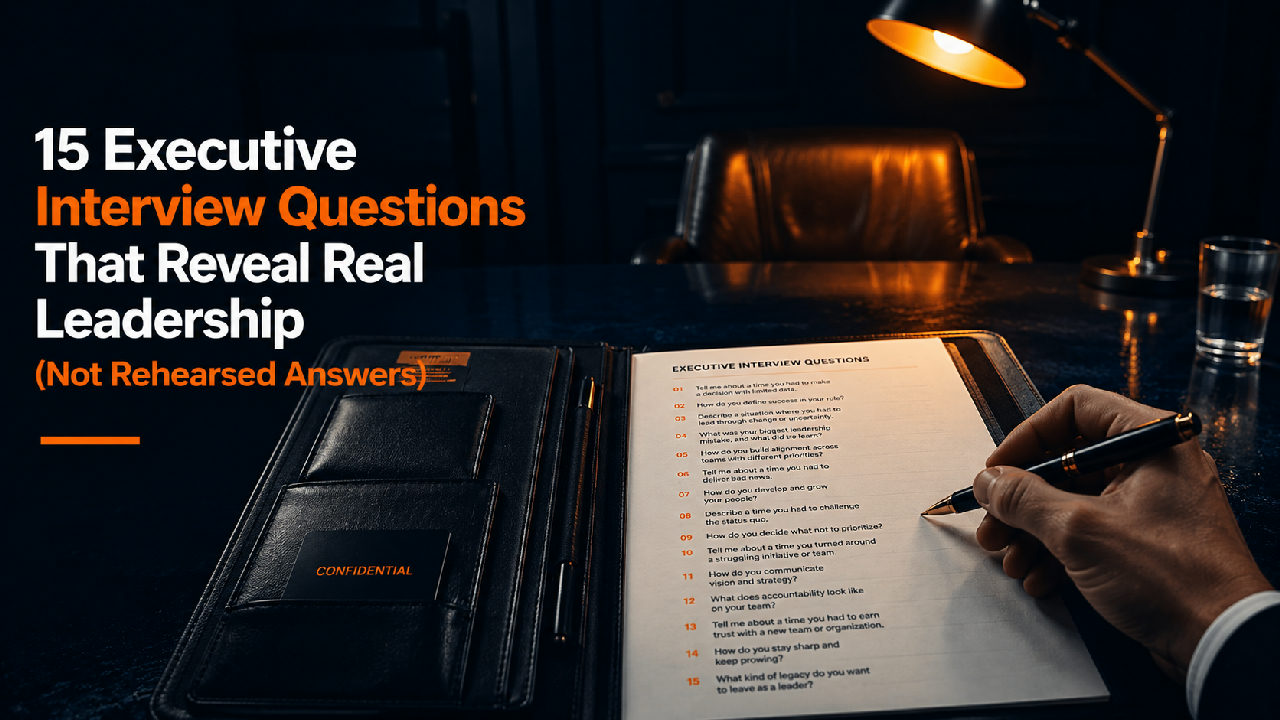
The standard executive interview is a polished performance on both sides. The candidate has answered every common question a hundred times. The hiring team asks the same questions every other company asked. Everyone is well-prepared. Almost no one learns anything new.
Real assessment requires questions the candidate hasn't already answered ten times this month. Questions that pull the candidate out of pre-rehearsed narrative and into specific operational memory. These are fifteen of the ones that consistently work, and what to actually listen for in the answers.
On How They Think About the Job
1. What's the most important decision you made in your last role that you'd make differently with what you know now?
The bad version of this answer is a humble-brag. The good version is specific, has a real consequence attached, and ends with a learning that affects how the candidate operates today. If they can't think of one, use it as a prompt for a follow-up rather than a final verdict: ask about a specific project instead and see if a concrete example surfaces.
2. Walk me through a time you fired a strong performer. Why, and what happened to the team after?
The ones who have made this kind of call understand that strong individual performance and team damage can coexist. Listen for whether they made the call cleanly, communicated it well, and watched the team respond. If they hesitate, follow up and ask what made the decision hard, rather than treating the hesitation itself as a verdict.
3. What's broken in your current company that you can't fix?
A real operator can usually answer this in thirty seconds with specifics, a process that doesn't work, a structural conflict between teams, a customer dynamic that compresses margin. If the answer is generic, probe further before drawing a conclusion; ask for a specific recent example.
On Operational Depth
4. What were your three biggest hires in your last role, and what made them work?
Strong leaders have a clear hiring philosophy. They can tell you who they hired, why those people specifically, what the offer process looked like, and how each one performed. Weak leaders deflect into HR-language generalities.
5. What's the metric you cared about most last quarter, and what was the actual number?
Real operators are fluent in their numbers. They don't need to look anything up. They know the trailing trend, the leading indicator, and what moved it. Foggy answers here are worth a follow-up: ask them to walk through how they'd find the number, and see how quickly the gap closes.
6. Walk me through your last forecast: what you committed to, what you delivered, and the gap.
For revenue, finance, or operations leaders, this is the most useful question in the interview. The answer reveals both their forecasting discipline and their relationship to honesty about misses. The leaders who routinely beat or hit forecast can describe exactly how they got there. The leaders who routinely miss it tend to describe external conditions.
7. Describe a strategic bet your team made that didn't work, and how you killed it.
The willingness to kill a bet is a leadership signal. Many leaders are good at starting things. Few are good at stopping them. The candidate who can tell you when they pulled the plug (and how they handled the team, the budget, and the story) is operating at a higher level.
On How They Lead People
8. Who's the strongest person you've worked with, and what made them strong?
This answer reveals what the candidate notices in talent. The features they cite (clarity of thinking, ownership, communication, raw output) tell you what they value and likely what they hire for. Notice whether they cite peers, reports, or bosses; strong leaders learn from all three.
9. What's the hardest piece of feedback you've ever received, and what did you do with it?
Vague answers ("be more strategic") are worth probing further with a follow-up. Specific answers, "my COO told me I was rewriting strategy every quarter and the team couldn't keep up", point to real self-awareness. Ask a follow-up: did they actually change behavior, and can they describe how?
10. Describe a time you were wrong in front of your team. How did you handle it?
If a candidate can't produce a story here, follow up rather than concluding they're unsafe to disagree with; some people simply need a more specific prompt. Strong leaders will typically give a clean, specific example without over-narrating the redemption arc, describing what they said, what changed, and what they learned.
Hiring for a leadership role? A 20-minute conversation will pressure-test the role before you post it.
On Stage and Fit
11. What does the first ninety days in this role actually look like for you?
The bad version is a generic "listen and learn" tour. The good version is specific to your business: the people they'd meet, the data they'd want, the decisions they'd defer, the things they'd want to ship in the first sixty days. Real candidates have already started thinking about your seat before they walk in.
12. What's the difference between this stage of company and the stage you're operating in now?
You're listening for whether they understand the actual operating differences: process, decision speed, ambiguity tolerance, team capability gaps. If their answer is "we'd just move faster," that's a candidate who has not actually thought about the change. Companies are not just bigger or smaller versions of each other.
13. What's a question you wish I'd asked you?
This is more diagnostic than it sounds. Strong candidates will use this to surface something the interview missed, usually a topic they think is critical to the role. Weak candidates will say "nothing, I think we covered it." The leaders who proactively shape the conversation in their interview tend to proactively shape conversations on the job.
On Closing the Interview
14. What's the thing about this opportunity that gives you the most hesitation?
An answer of "nothing" is worth a follow-up rather than a final read; ask what would have to be true for them to walk away, and see what surfaces. Strong candidates will tell you the truth (the stage isn't quite their last one, the comp is below their target, the product space is new to them) and will offer their own thinking on whether that hesitation should be a blocker. This conversation is one of the most predictive of whether they'll accept the offer.
15. If you and I are sitting here in twelve months and this is the best hire we've made in years, what's true?
The answer reveals what the candidate believes the role is for. Strong candidates anchor on a small number of specific, measurable outcomes, not on vague themes. If the candidate's twelve-month vision and your twelve-month expectation don't match, the offer process needs another conversation, not a paperwork close.
How to Use These Questions
These questions don't work as a list to march through. They work when they're woven into a conversation that respects the candidate's time, gives them room to think, and follows up on real answers with real follow-ups. The follow-up is often where the truth lives.
A few principles for using them well:
Ask for specifics, not opinions. Most candidates have opinions ready. The story of a specific decision in a specific quarter with specific people is harder to fake.
Don't fill silence. Strong candidates use silence to think. Filling it with the next question rewards rehearsed answers and punishes deeper ones.
Follow up with "what would you do differently?" Almost any answer becomes more informative when you press for the second-order reflection.
Compare across candidates, not against a hypothetical ideal. The most useful evaluation is relative: which of these three finalists made the best decision in their version of question 4?
If you're staffing an executive search and want help building an interview process that actually surfaces signal, and not just polish, Talent Authority Partners runs structured evaluation frameworks tuned to the specific seat you're hiring for. We help our clients leave the conversation with real evidence, not a vibe.

Jonathan Tureau
Founder & Principal Recruiter, Talent Authority Partners
Founder-led, on every search. 17 years in recruiting, and a third-generation recruiter.
About JonathanHiring for a leadership role? A 20-minute conversation will pressure-test the role before you post it.
Related reading
The 90-Day Executive Onboarding Plan That Reduces Early Turnover Risk
Executive turnover is often blamed on the hire, but onboarding plays a real role too. Here's the 90-day plan that reduces early turnover risk and closes the gap between a great hire and a great fit.
Jonathan Tureau · May 14, 2026 · 5 min read
How to Write an Executive Offer Letter That Gets Signed
An executive offer letter should be written for clarity and candidate experience, not just legal precision. The companies that consistently close finalists understand that, and write the letter that way.
Jonathan Tureau · May 14, 2026 · 6 min read
How to Beat the Counter-Offer: A Hiring Manager's Closing Playbook
A counter-offer at the end of a long search is the moment most hiring managers either close or lose. The ones who close don't do it by paying more. They do it by running a different process from week one.
Jonathan Tureau · May 14, 2026 · 5 min read