Executive Search Firms vs. In-House Recruiters: When to Outsource Leadership Hiring
Your in-house recruiting team is excellent at certain hires and structurally unequipped for others. Knowing which is which is the difference between filling a leadership seat in ninety days and watching it sit open for nine months.
Updated
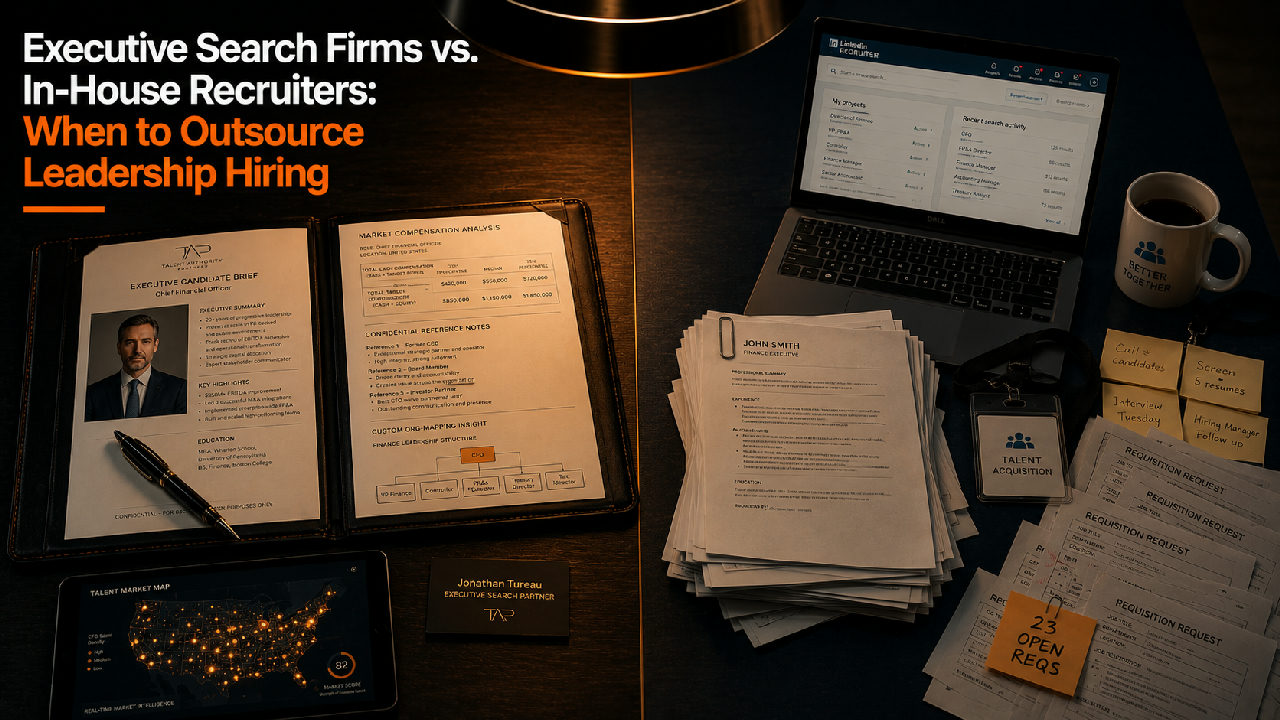
Internal talent teams are not bad at executive search. They're just built for something else. The same recruiter who is brilliant at closing a senior software engineer is rarely equipped to run a market-mapped search for a VP of Finance who isn't actively looking. That isn't a knock on the recruiter. It's a fact of how the role is structured.
The question isn't whether your in-house team is "good enough." It's whether the role you're trying to fill matches the kind of search your team is built to run.
What In-House Recruiters Are Genuinely Great At
A strong internal recruiting team has structural advantages no outside firm can replicate. They live inside the company. They know the hiring managers, the culture, the comp bands, the team dynamics. They can move candidates through the process with informal speed: a quick Slack to a hiring manager, a same-day debrief, a real-time read on whether the team is excited.
In-house teams excel at:
Roles with active candidate pools and inbound interest
Engineering, product, and design at most levels
Volume hiring where pattern recognition compounds
Closing candidates who already know the company
Building employer brand over time
For these searches, an outside firm often slows things down rather than speeds them up. The in-house team is the right answer, full stop.
Where In-House Teams Structurally Struggle
The places where in-house teams hit a wall aren't about effort. They're about what the structure allows.
Passive market reach. Most internal recruiters are running 8-20 reqs at once. They cannot also be cold-calling thirty senior leaders a week to develop relationships with passive talent. The math just doesn't work. So they rely on inbound, referrals, and what's visible on LinkedIn, and that's a narrow slice of the real market for $200k+ leaders.
Confidentiality. Replacing an existing executive, exploring a new business line quietly, or running a sensitive search through internal channels is structurally awkward. The internal team is part of the org chart. They can't always run a search the way it needs to be run when the search itself is the news.
Specialized expertise. A recruiter who's spent five years closing engineers does not, by sitting down at their desk on Monday, suddenly know how to evaluate a CFO. The signals are different. The market is different. The conversations are different. Expecting depth across every function is a fair ask of a small team only in theory.
Time-to-fill at the top. Senior searches require longer outreach cycles, more touches, and more patience than mid-level roles. Internal teams under pressure to fill a queue of fifteen roles can't always give a single role the eight to twelve weeks of attention it actually needs.
The Decision Framework
Three factors should drive the build-versus-buy decision on any given search.
1. Role seniority and scarcity. The more senior and specialized the role, the more the search benefits from an outside firm that maps the full passive market. A Director of Engineering is usually fillable in-house. A VP of Engineering with deep platform experience usually isn't.
2. Internal bandwidth. Even a great internal team has finite hours. If your team is already maxed and you add a leadership search on top, you'll likely get a thinner search than the role deserves: through no fault of the team. Recognizing capacity honestly is part of the decision.
3. Confidentiality and sensitivity. Anything that needs to be quiet (replacing a current leader, exploring a stealth product line, navigating a sensitive transition) almost always belongs with an outside partner.
Hiring for a leadership role? A 20-minute conversation will pressure-test the role before you post it.
The Hybrid Model That Actually Works
The smartest companies don't treat this as either/or. They treat it as a partnership.
In the hybrid model, the internal team owns volume hiring, brand-building, and most director-and-below roles. An outside search partner runs the leadership and specialized roles where their model has structural advantage. The two collaborate (sharing intel, comp data, candidate feedback) instead of competing.
Done well, this model produces better hires than either side could deliver alone. The internal team stays focused on what it's built for. The outside firm goes deep on the few roles where deep matters most. Hiring managers get a consistent experience either way.
What to Look For in an Outside Partner
If you decide to bring in an executive search firm, the choice isn't binary. There are three rough categories, and each behaves differently.
Large global firms. Deep databases, big teams, established brand. Slow to start, expensive, and your role often gets handled by a less-senior member of the team while the partner who closed you stays out of the day-to-day.
Niche/boutique firms. Smaller client roster, partner-level attention on every search, specialized depth in specific functions or industries. Tends to be faster, more responsive, and more honest about what's working in the search.
Contingent agencies. Transactional. No exclusivity, no committed timeline, paid only on placement. Useful for some mid-level roles. Often a weaker fit for leadership hiring, where depth of search and commitment to the mandate matter more.
The right partner depends on the role, the stakes, and how much partner-level attention you actually need. A boutique firm working three searches at a time will run your search differently than a large firm working a hundred. Neither is universally better, but for senior leadership hires, partner-level attention tends to win.
There's also a middle path worth considering: embedded recruiting, where a dedicated search partner works inside your team on an ongoing basis rather than search by search. It can be a strong fit for companies with steady leadership hiring volume.
When to Bring in a Partner Sooner, Not Later
Companies often bring in outside help only after a search has stalled. That works, but it's not the cheapest path.
The cheaper path is honest assessment up front. If a role is leadership, senior, specialized, time-sensitive, or sensitive: bring in the right partner from day one. If it's a role your internal team has hired three times in the last year, keep it internal. The faster you make that call, the less time you waste on a search that was never going to finish on the path it started.
Talent Authority Partners works with companies of every size, from founder-led startups to enterprise teams, on leadership and executive searches. We'll be honest about whether a role belongs with us, with your team, or with both.

Jonathan Tureau
Founder & Principal Recruiter, Talent Authority Partners
Founder-led, on every search. 17 years in recruiting, and a third-generation recruiter.
About JonathanHiring for a leadership role? A 20-minute conversation will pressure-test the role before you post it.
Related reading
The 90-Day Executive Onboarding Plan That Reduces Early Turnover Risk
Executive turnover is often blamed on the hire, but onboarding plays a real role too. Here's the 90-day plan that reduces early turnover risk and closes the gap between a great hire and a great fit.
Jonathan Tureau · May 14, 2026 · 5 min read
How to Write an Executive Offer Letter That Gets Signed
An executive offer letter should be written for clarity and candidate experience, not just legal precision. The companies that consistently close finalists understand that, and write the letter that way.
Jonathan Tureau · May 14, 2026 · 6 min read
How to Beat the Counter-Offer: A Hiring Manager's Closing Playbook
A counter-offer at the end of a long search is the moment most hiring managers either close or lose. The ones who close don't do it by paying more. They do it by running a different process from week one.
Jonathan Tureau · May 14, 2026 · 5 min read